The smart manufacturing maturity model: you can't skip a level
Five levels from paper-driven to AI-enabled. Where most factories really are, where AI starts to pay back, and why there are no shortcuts.
The first question in any transformation is simple: where are you today?
Not where your last board presentation said you are. Where you actually are.
I've met plenty of organisations that describe themselves as "well on the way to digital transformation", while still printing production orders and tracking quality in spreadsheets. That's not a criticism. It's just very common. And you can't plan a route if you're lying to yourself about the starting point.
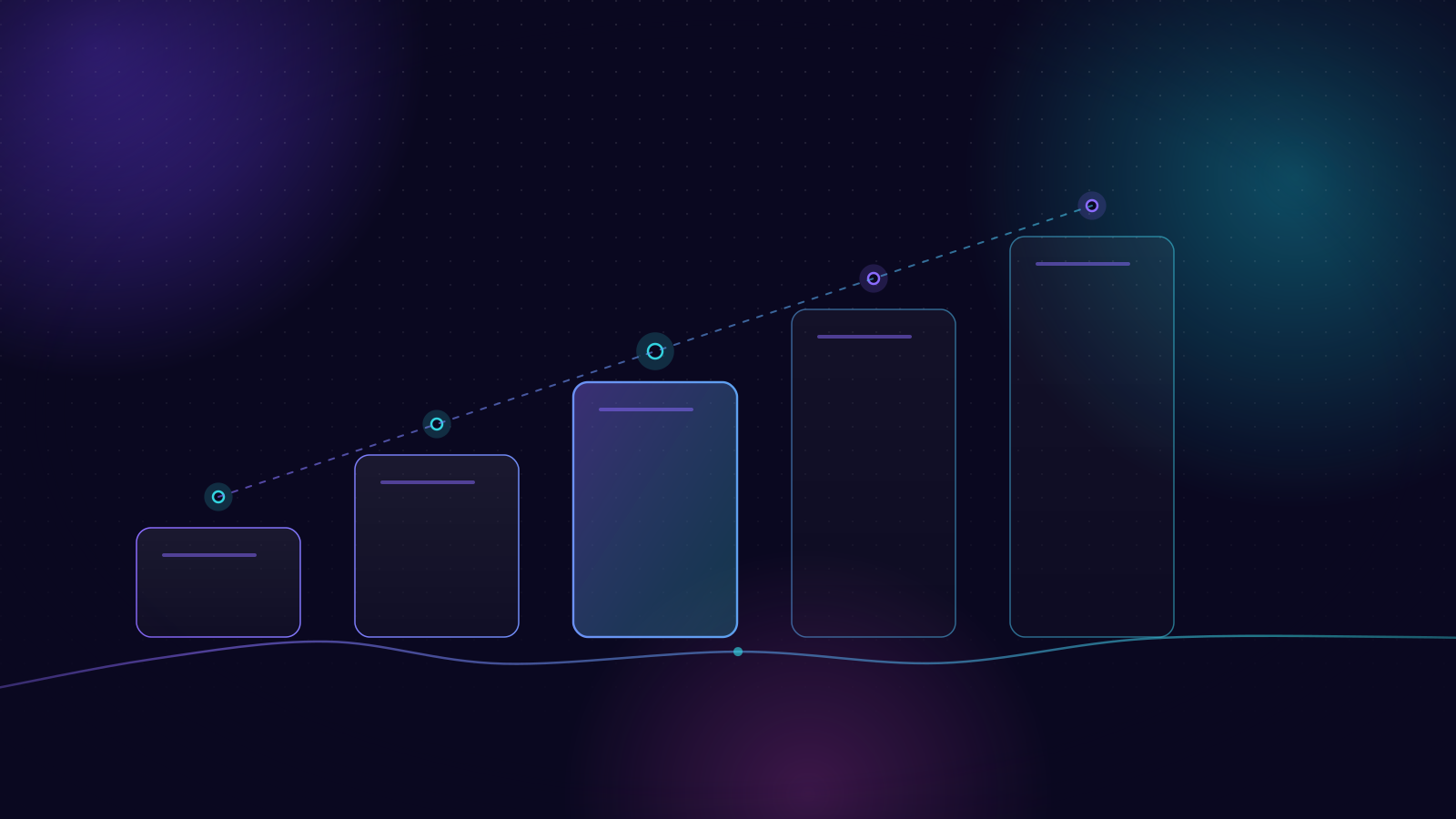
The model I use is adapted from the Capability Maturity Model Integration (CMMI). Five levels, each building on the last.
Level 1: Initial
Paper-driven manufacturing. Little or no automation. Data collection is manual, if it happens at all.
Visibility is low. You rely on experienced people to keep things running, and when they're off, things wobble. Most of the knowledge about how the factory works lives in people's heads.
How you'll recognise it: travellers on clipboards, downtime on a whiteboard, a morning meeting that starts with someone reading out yesterday's numbers from a notebook.
Level 2: Managed
Basic digital. You've started to reduce the dependence on paper. Processes are documented, maybe not perfectly, but they exist.
Some digital point solutions are in play. Perhaps an OEE tool on a couple of lines, a checklist app, a quality spreadsheet that's grown macros. Knowledge is easier to find. But data capture is still largely manual and the systems don't talk to each other.
How you'll recognise it: three or four tools that each solve one problem, and a weekly report someone builds by copying between them.
Level 3: Defined
Integrated systems on the shopfloor. This is usually where MES/MOM arrives as the operational backbone, connecting the shopfloor to ERP and bringing production, quality, inventory and maintenance onto the same data.
Automatic data capture replaces manual entry. Processes are validated and error-proofed in real time, with standard operating procedures built into the system. You track OEE, quality and downtime with real data rather than estimates.
How you'll recognise it: operators work from one screen, and nobody argues about whose downtime figures are right.
Level 4: Quantified
A connected business. MES/MOM, ERP, PLM, scheduling, quality and data platforms share data through a deliberate architecture. One source of truth, with the right system for each person: operators in MES/MOM, planners in ERP and APS, managers in dashboards.
Sensor coverage expands. Automation increases. And you move from reactive to proactive: condition-based maintenance, early warnings, problems flagged before they become failures.
How you'll recognise it: maintenance gets scheduled because the data says so, not because the calendar does.
Level 5: Optimised
Data-driven and AI-enabled. Systems that don't just inform decisions but make some of them. Predictive analytics with feedback loops. Models that improve over time. Repetitive work automated across functions.
How you'll recognise it: honestly, you probably won't, because very few factories are genuinely here, whatever their marketing says.
Where AI starts to pay back
This is the part that matters most right now.
AI value rises with maturity. At Level 1 there's no data for AI to work with. At Level 2 you're collecting some, but it's inconsistent. At Level 3 you have reliable, automatic, contextualised data, and AI finally has something to learn from. At Level 4, with a single source of truth across systems, it can start making meaningful predictions. At Level 5 it's embedded in how you operate.
Everyone wants to be at Level 5. But if you're at Level 1 or 2, the path to Level 5 goes through Levels 3 and 4. There are no shortcuts. I cover why in more depth in AI won't fix your factory.
Most factories are between 1 and 3
That's my experience across a lot of factories. A few are at Level 4. Very few are genuinely at Level 5.
And that's fine. Each step delivers value on its own. Going from Level 1 to Level 2 removes paper and gives you basic visibility. Going from 2 to 3 is usually the biggest jump in value, because it's where data becomes trustworthy and departments start working from the same picture.
How to use the model
The model gives you two things.
First, an honest assessment of where you are. Do it line by line and site by site if you need to. It's common for one plant to be at Level 3 and another at Level 1.
Second, a roadmap. You don't need to jump from 1 to 5 in one project. Move one level at a time, and make sure each step is built on a platform that can carry you to the next. Plenty of Level 2 factories get stuck because the point solutions they bought can't grow into Level 3.
Be honest with yourself. If you're printing travellers and tracking downtime on whiteboards, you're at Level 1. Knowing that is the first step in planning the work.
So, where would you put your factory today, and where would your leadership team put it?

Matt Barber
VP & General Manager for MES at Infor. Started as an MES developer, then ran projects, solution design and product. Writes about the smart factory, shopfloor AI and the MES/MOM foundations underneath them.