Connected worker: why your operators need one app, not five
Connected worker solves real frontline problems. Bought as a standalone tool, it creates new ones. Why it belongs inside your MES/MOM, not alongside it.
"Connected worker" is everywhere right now. Every vendor website. Every trade show stand.
And for once, the buzz is pointing at something real. The frontline is where manufacturing is under the most pressure, and the tools most operators have been given are terrible.
So I'm a big believer in connected worker. What I want to unpick is how you buy it, because that decision will shape your operators' day for the next ten years.
What is connected worker?
A connected worker capability is the digital layer between your frontline people and everything they need to do their job well. In practice:
- Digital checklists and task management
- Shift handover that doesn't rely on a scribbled note or a quick chat at the door
- Skills and certification tracking, enforced at the point of work
- Documents, SOPs and work instructions, always the latest version
- Health and safety procedures and sign-offs
Each of these replaces something that, in most factories, still runs on paper, whiteboards or memory.
Why it matters now
The workforce problem is not a future problem.
72% of industrial organisations say frontline workforce issues have hurt their operational performance (LNS Research, 2023). Your most experienced people are approaching retirement, and the knowledge that keeps your lines running lives in their heads, not in any system. Median tenure in US manufacturing is now 4.9 years (USAFacts), so the people replacing them won't be around long enough to absorb it the old way.
And the gap is getting wider. Deloitte and the Manufacturing Institute estimate US manufacturing could need as many as 3.8 million new employees between 2024 and 2033, and that 1.9 million of those jobs could go unfilled (Manufacturing Institute, 2024). In the same release, 65% of manufacturers named attracting and retaining talent as their primary business challenge.
That changes the job of shopfloor software. It's no longer enough to record what happened. It has to guide a new starter through the process so they get it right on their second day, not their second year.
Connected worker capabilities do exactly that. Which is why spending on them is growing fast, with Verdantix expecting the market to reach $3 billion by 2026, driven largely by labour shortages (Verdantix).
The problem with standalone connected worker platforms
Here's where I have a strong opinion.
Standalone connected worker platforms only get you so far. They very quickly bump into applications with much deeper functionality.
Think about what an operator actually does in a shift. They don't just tick checklists. They:
- Run production orders, with changeovers, counts, scrap and downtime
- Perform quality inspections and take samples for the lab
- Consume raw materials and label what they produce
- Carry out autonomous maintenance on their equipment
- Manage tooling and setups
A standalone connected worker tool does none of that. It handles the people side well, but it has no production context. It doesn't know which order is running. It can't trigger a quality check because a batch of raw material changed. It can't stop someone consuming a quarantined lot.
So here's what usually happens. You implement a connected worker tool for the quick wins: digital checklists, shift handover, task boards. It works. People like it. Then you realise you need production execution, quality and traceability, so you implement an MES/MOM alongside it.
Now your operators are using two systems. Two logins. Two places to look when something goes wrong. Your data model is split down the middle, and someone has to integrate the two.
Nobody wants to feel like they're working blind, switching between screens and trying to piece together what's happening.
One screen, one source of truth
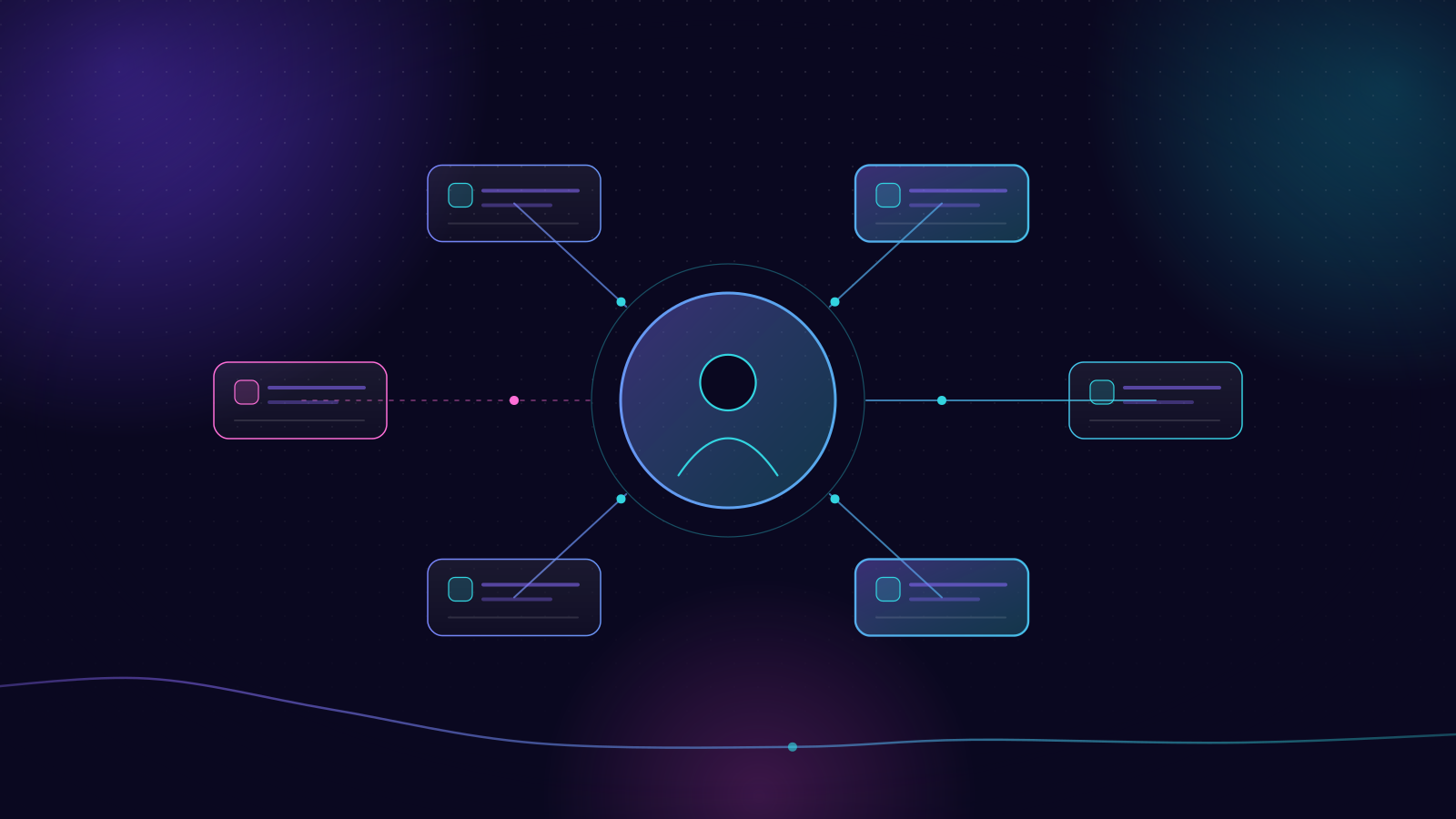
The answer isn't less connected worker. It's connected worker in the right place: built into your MES/MOM, not bolted on beside it.
When it's part of the same platform, everything changes:
- Checklists know the context. A start-up checklist appears because this order is starting on this line, not because it's 6am.
- Quality checks are triggered by events. A material change, a tool change or a count threshold prompts the right inspection automatically.
- Skills are enforced, not just recorded. An operator who isn't qualified on a machine can't start an order on it.
- Shift handover is built from real data. The incoming crew sees what ran, what stopped and what's waiting, rather than whatever someone remembered to write down.
The operator gets guided through their whole job, with full context of what's happening around them. And every action they take feeds the same data the quality team, the maintenance team and the planners are using.
That's the bit people miss. Connected worker isn't just a better experience for operators. It's how frontline knowledge gets into your single source of truth, instead of living in a separate app nobody else looks at.
Where connected worker fits in your roadmap
I'm not telling you to skip the quick wins. Connected worker is often the best place to start. Going paperless on checklists and handover delivers value in weeks, and it builds trust with the shopfloor early.
The question is what you start on.
If you buy standalone, you get quick wins. Then you hit the ceiling, and you're either replacing the tool or integrating it with something deeper. Your operators pay the price either way.
If you choose an MES/MOM with connected worker built in, you get the same quick wins on day one, on a platform that grows with you into production, quality, inventory and maintenance. One system, one data model.
Start with the end in mind. Connected worker is the front door. MOM is the house behind it. Make sure you're buying a door that's attached to a house.
A word of caution
The connected worker market is full of lightweight tools that look brilliant in a demo. Nice mobile screens, quick to configure, an easy sell to a frustrated operations manager.
Be wary of choosing a point solution that solves today's problem and creates tomorrow's headache. Ask any vendor:
- What happens when we need production execution and quality on the same screen?
- How does a checklist know which order, material and machine it relates to?
- Can skills block an action, or only report on it?
- If we add your MES/MOM modules later, is it the same data model or another integration?
The answers will tell you very quickly whether you're buying a platform or a stop-gap.
Have you implemented a standalone connected worker tool and then needed MES/MOM on top? I'd genuinely like to hear how that went.

Matt Barber
VP & General Manager for MES at Infor. Started as an MES developer, then ran projects, solution design and product. Writes about the smart factory, shopfloor AI and the MES/MOM foundations underneath them.